Tag: news

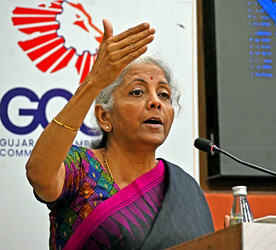
  • Finance Minister Nirmala Sitharaman: Industry Must Advance Up the Manufacturing Value Chain

    Finance Minister Nirmala Sitharaman: Industry Must Advance Up the Manufacturing Value Chain

    nirmala sitharaman

    Finance Minister Nirmala Sitharaman: Industry Must Advance Up the Manufacturing Value Chain

    Addressing a session on “Co-Creating the Future Responsibly: The Role of Business” at CII’s Annual Business Summit in New Delhi, Dr. V Anantha Nageswaran, Chief Economic Advisor, Government of India, emphasized the need to increase the share of manufacturing in the economy.

    “As India progresses from being the tenth largest to the fifth largest economy, aspirations rise along with such key milestones. It is important to recognize these aspirations and strive to meet them for a better standard of living,” he stated.

    Dr. Nageswaran highlighted several key priorities for achieving developed nation status, including improvements in human resource development, which are critical for higher economic growth. He emphasized the importance of cities as ecosystems for attracting talent and fostering entrepreneurship, innovation, and creativity. Converting India’s Tier 2 and Tier 3 cities into engines of growth, improving learning outcomes, preparing the youth for AI adoption, and focusing on physical health were identified as key focus areas.

    He stressed the creation of a vibrant small and medium enterprises sector, known as ‘Mittlestand’, and highlighted the importance of deregulation and lighter compliance burdens for MSMEs. Addressing factors of production such as land and labor markets and making power generation and distribution economically viable were also emphasized.

    Dr. Nageswaran pointed out the need for dialogue and consensus building with stakeholders to implement next-generation reforms amidst challenges from geopolitical fragmentation and climate change. He emphasized the importance of macroeconomic stability, prudent and sustainable government finance, and improved credit ratings, especially given the high geopolitical risks.

    He cautioned against taking the global environment for granted, citing risks such as geopolitical fragmentation, the impact of US fiscal policy and interest rates, China’s dominance in global manufacturing, and global financial stability. He stressed that the government cannot address these challenges alone and that private sector support is critical for societal advancement and a faster energy transition.

    Dr. Nageswaran also stressed the importance of social responsibility in innovations, including AI’s impact. He reiterated that Corporate Social Responsibility is integral to corporate responsibility, and meaningful actions across all areas are crucial for responsibly co-creating the future. (ANI)

  • TGIF Agribusiness Makes Strong Debut on BSE SME Platform with 61% Premium

    TGIF Agribusiness Makes Strong Debut on BSE SME Platform with 61% Premium

    TGIF-Agribusiness

    TGIF Agribusiness Makes Strong Debut on BSE SME Platform with 61% Premium

    TGIF Agribusiness made its debut on the BSE SME platform on Wednesday with shares opening at Rs 150, representing a premium of 61% over the issue price of Rs 93 per share.

    Prior to its listing, the company’s shares were trading at a premium of Rs 30 in the unlisted market.

    The Initial Public Offering (IPO) consisted of a fresh equity issue of 6.87 lakh shares and was oversubscribed 37 times due to strong interest from investors.

    The proceeds from the IPO will be utilized for purchasing agricultural equipment and irrigation systems, meeting working capital requirements, and for general corporate purposes.

    TGIF Agribusiness primarily operates as a horticulture company engaged in open farming of fruits and vegetables across more than 110 acres of farmland in Ajari, Kasindra, and Kojra villages.

    Pomegranate farming constitutes over 95% of the company’s revenue, supplemented by cultivation of dragon fruits, Sagwan trees, lemon, watermelon, and chilly in recent years.

    The company employs various farming techniques to ensure high-quality produce, such as fruit thinning to enhance crop size and quality, vegetative growth practices, fruit protection measures, and soil moisture management.

    The agriculture sector in India, boasting the world’s second-largest agricultural land, plays a pivotal role in employing nearly half of the country’s population, making farmers essential contributors to our sustenance.

  • The Uttar Pradesh government aims to attract investments of Rs 5,000 crore for the Defence Manufacturing

    The Uttar Pradesh government aims to attract investments of Rs 5,000 crore for the Defence Manufacturing

    Defence Industrial Corridor (UPDIC)

    The Uttar Pradesh government aims to attract investments of Rs 5,000 crore for the Defence Manufacturing

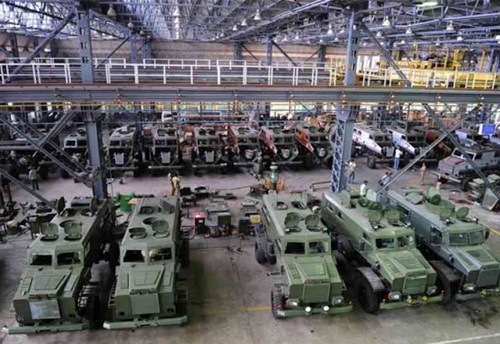
    The Union Environment Ministry has granted approval for the development of 60 hectares of land dedicated to the Uttar Pradesh Defence Industrial Corridor (UPDIC) in Chitrakoot.

    According to the Expressway Industrial Development Authority (UPEIDA), this approval will facilitate projects worth Rs 5,000 crore, potentially creating 100,000 job opportunities in Chitrakoot.

    A significant portion of Chitrakoot will be reserved as a greenbelt, and developers will incorporate modern measures for energy conservation, waste management, firefighting, and controlling noise, water, and air pollution. The UPDIC encompasses six nodes across Lucknow, Kanpur, Jhansi, Aligarh, Chitrakoot, and Agra districts.

    “This corridor is crucial for advancing the ‘Make in UP’ initiative of the Yogi Adityanath government and contributing to India’s military self-reliance and exports,” said a government official. The corridor will focus on producing drones, helicopters, arms, and ammunition.

    The state government has already approved defence manufacturing projects worth Rs 25,000 crore and signed 140 memorandums of understanding (MoUs) with both public and private companies. These MoUs include agreements with Adani Defence and Aerospace, BrahMos Aerospace, Ancor Research Labs, Tata Technologies, Bharat Dynamics Limited, Delta Combat Systems, SpiceJet Technic, Verivision, HAL, Gliders India, Defence Research & Development Organisation, Aerolloy Technologies, and others.

    The Expressway Authority plans to acquire nearly 5,000 hectares for UPDIC, with about 1,700 hectares already acquired and allotted to investors. Additionally, approximately 1,000 hectares have been allocated to investors in Jhansi for developing a hub dedicated to arms and ammunition production and testing, with Bharat Dynamics as the lead investor in Jhansi.

  • SEBI Plans Stricter Rules for SME Public Offers Amid Market Surge

    SEBI Plans Stricter Rules for SME Public Offers Amid Market Surge

    SEBI

    SEBI Plans Stricter Rules for SME Public Offers Amid Market Surge

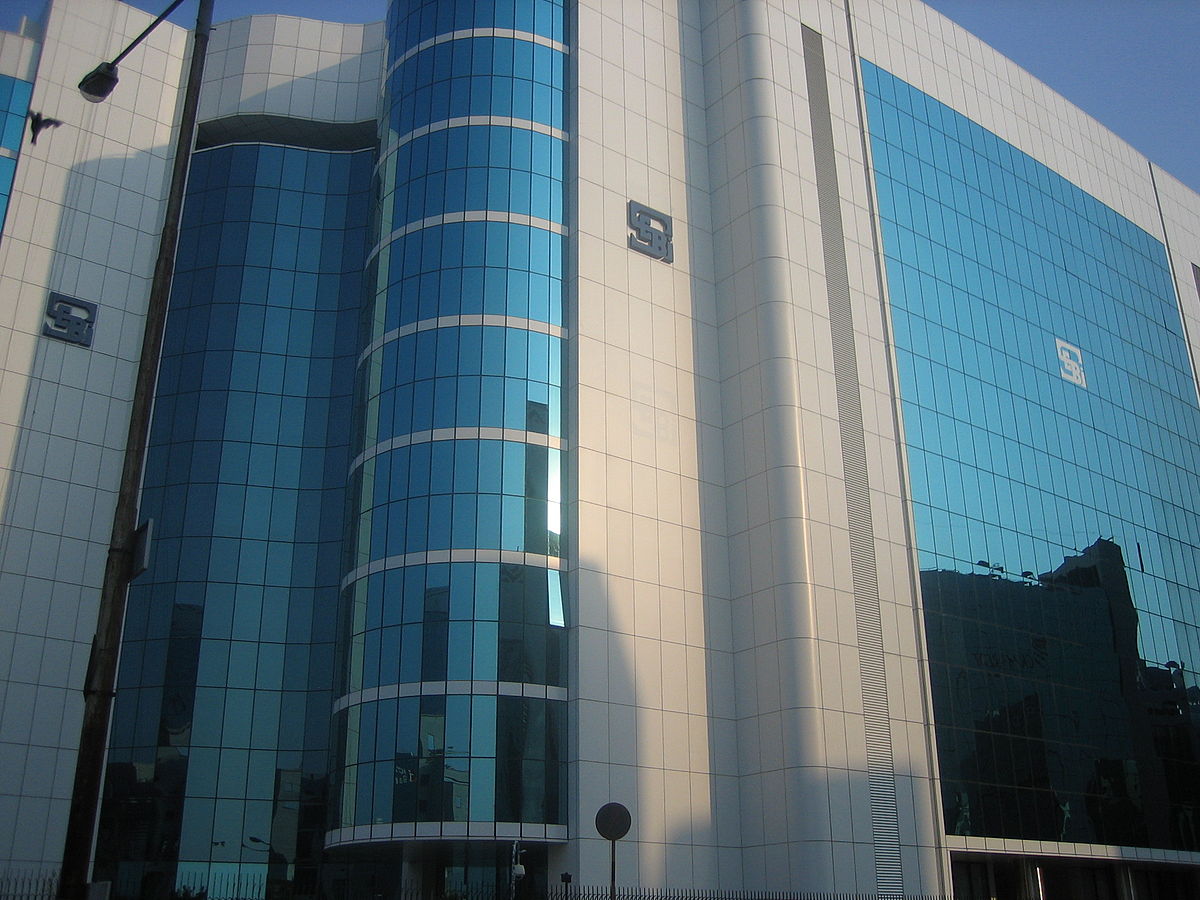
    India’s capital markets are on the brink of a regulatory overhaul as the Securities and Exchange Board of India (SEBI) prepares to tighten regulations governing public offerings by small and medium enterprises (SMEs). This initiative responds to increasing concerns over the misuse of a specialized listing platform introduced in 2012 to facilitate small businesses’ access to capital markets.

    According to Reuters reports, SEBI is considering raising the minimum size requirement for such public offerings to between Rs 30 crore and Rs 50 crore ($3.59 million to $5.99 million). Sources from Reuters indicated that the proposed rules are expected to be officially issued later this year following consultations with stakeholders.

    Currently, there is no prescribed minimum issue size for SMEs, although companies listing on the platform are required to have a post-issue capital base of Rs 25 crore. “Establishing a minimum offer size will ensure that serious companies access the capital markets, thereby protecting investor interests,” commented one of the sources. This initiative demonstrates regulators’ commitment to fortify investor protection mechanisms amidst increased activity in India’s equity markets.

    Data from PRIME Database, a leading capital markets information provider, reveals a rise in public offerings by SMEs during the fiscal year ending March 2024. A total of 205 companies raised Rs 6,000 crore, marking an increase from the previous year’s 125 firms that raised Rs 2,200 crore.

    Despite repeated requests for comments, both the markets regulator and exchanges, tasked with implementing regulatory policies, refrained from responding. The move to tighten regulations surrounding SME public offerings reflects a broader trend towards enhancing market integrity and investor confidence. By imposing stringent criteria for accessing capital markets, authorities aim to eliminate frivolous listings while fostering an environment conducive to sustainable growth.

    In recent years, India’s SME segment has emerged as a vital engine of economic expansion, contributing to employment generation and fostering innovation. However, concerns regarding corporate governance standards and regulatory oversight have lingered, prompting regulators to recalibrate existing frameworks to align with evolving market dynamics.

    Reports suggest that some SME issues were oversubscribed by 500 to 1000 times, raising concerns about the misuse of the listing platform. In response to these concerns, SEBI is considering imposing a minimum issue size for SMEs along with enhanced disclosure requirements. Companies eyeing public listings will be required to provide comprehensive disclosures, including the objectives of the issue, financials of the issuer, and associated risk factors.

    “The merchant bankers will be tasked with providing more upfront disclosures, ensuring investors have the necessary information to make informed decisions,” remarked a source privy to the discussions.

    SEBI’s proactive stance follows earlier remarks by its chairperson, Madhabi Puri Buch, who highlighted instances of misuse within the SME listing framework. Buch emphasized the regulator’s commitment to investigating complaints of price manipulation within the segment, stressing the need for heightened vigilance to maintain market integrity.

    In a crackdown on malpractices, SEBI recently barred three SME companies from accessing capital markets, citing misuse of funds raised through public offerings, including diversion for unauthorized purposes, misrepresentation of facts in offer documents, and alleged manipulation of financial statements.

    The regulatory clampdown underscores a broader push towards fortifying investor protection mechanisms and upholding market integrity. By establishing robust disclosure norms and imposing stringent penalties for non-compliance, SEBI aims to foster transparency and accountability within India’s SME space. As stakeholders anticipate the formal issuance of SEBI’s revised guidelines, market participants brace for a paradigm shift in the regulatory landscape, signaling a pivotal moment in India’s capital markets as authorities strive to balance promoting entrepreneurship with safeguarding investor interests.

  • OpenAI’s new search engine

    OpenAI’s new search engine

    OpenAI’s new search engine may change marketing

    open ai

    Open AI has been changing the way users browse the web. Imagine users asking questions in a natural way, just like they would a friend. OpenAI’s search engine might be built for this conversational approach, requiring marketers to adapt their content to sound natural and answer real user questions.

    Excitement is building for OpenAI’s search engine, and it has the potential to disrupt the search landscape as we know it. However, some questions linger. Can OpenAI make money with this new service? And can it truly compete with the mighty Google? One thing’s for sure: the search engine world is a hotbed of innovation and fierce competition, and OpenAI’s arrival just adds another layer of intrigue.

    Marketers might need to track new metrics to understand how users find and engage with their content in this new search landscape.

    AI search engines might throw SEO for a loop These new search engines, unlike their traditional counterparts, may value different things. They could prioritize content written in a more conversational style, focus on new ranking signals we haven’t seen before, or even interpret what users are really looking for in a completely different way. Since AI can understand and create human-like text, content that directly answers users’ questions in a natural, conversational way might be the key to ranking highly.

    OpenAI’s search engine could change the search game Google has been the undisputed king for ages, but if OpenAI takes off, it could shake things up big time. Marketers will need to ditch their “all eggs in one basket” approach and start spreading their SEO efforts across different platforms to stay competitive.

    Overall, OpenAI Search presents both challenges and opportunities for marketers. Being adaptable and creative will be key to success in this evolving search landscape.


    To learn more, read here: https://www.cmswire.com/digital-marketing/what-openai-search-would-mean-for-marketers/

  • What is AI doing to the environment?

    What is AI doing to the environment?

    AI is bad for the environment. But it can be better.

    Barely a few years have passed, but it feels like we can’t live without AI anymore. Of course, AI has also had its fair share of criticism, but these seem to focus on its ethical and moral impact. Less light is shed on the environmental impact, which has been great indeed. 

    As AI models become more complex, more energy is required to train and run them. This results in greenhouse gas emissions that contribute to climate change. Researchers estimate that the amount of computing power required to train cutting-edge AI models has doubled every 3.4 months since 2012.

    E-waste from AI hardware contains hazardous chemicals that can harm human health and the environment. The World Economic Forum projects that the total amount of e-waste generated will have surpassed 120 million metric tonnes by 2050. Proper e-waste management and recycling are essential to avoid environmental harm.

    AI applications like driverless cars and delivery drones can pose a threat to animals and their habitats. The automation brought about by AI may also lead to increased consumption and waste in certain sectors. The use of AI in agriculture could result in the overuse of pesticides and fertilizers, harming biodiversity. AI systems used for environmental management can also be biased if trained on inaccurate or incomplete data.

    Some companies prioritize financial gain over the environmental impact of AI technologies. The complexity of AI systems makes it difficult for users to understand their environmental footprint. To address this issue, more transparent procedures and regulations are needed to ensure that AI is developed and used in an environmentally responsible way.

    The undeniable potential of AI cannot overshadow the environmental threats it poses. From its massive energy consumption to its contribution to e-waste and disruption of ecosystems, AI’s environmental impact necessitates immediate action. Transparency and responsible development are crucial to ensure AI becomes a tool for a sustainable future, not a detriment. There need to be work done to highlight these challenges and foster a dialogue that paves the way for AI advancements that coexist harmoniously with our planet.


    Read more here:https://www.nytimes.com/2024/05/06/business/dealbook/ai-power-energy-climate.html

  • Secretary, Department of Pharmaceuticals launches the MEDITECH STACKATHON 2024 in collaboration with CII at New Delhi

    Secretary, Department of Pharmaceuticals launches the MEDITECH STACKATHON 2024 in collaboration with CII at New Delhi

    MEDTECH industry

    Department of Pharmaceuticals launches the MEDITECH STACKATHON 2024 in collaboration with CII at New Delhi

    India’s MEDTECH industry holds immense potential with projections estimating a growth rate of 28% annually: Dr Arunish Chawla

    Industry captains and key stakeholders to brainstorm on the Value Chain Mapping of the select medical devices to facilitate meaningful discussions on the way forward

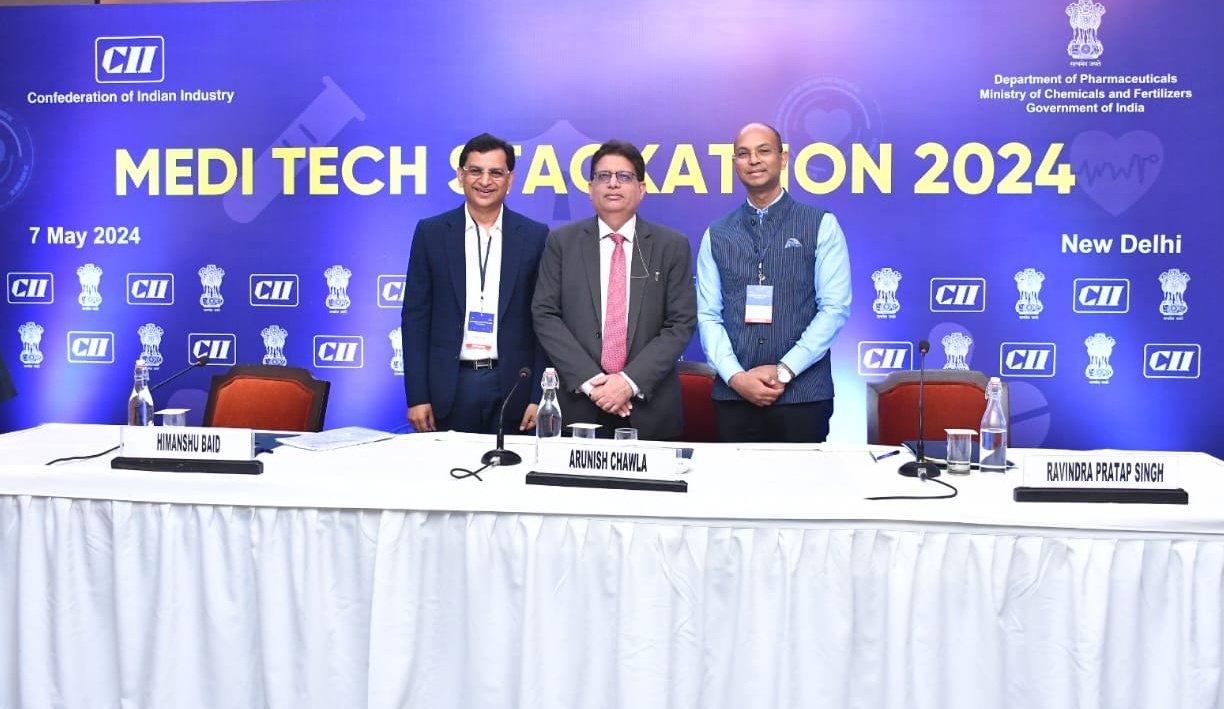
    Secretary, Department of Pharmaceuticals, Ministry of Chemicals and Fertilizers Dr Arunish Chawla, launched the MEDITECH STACKATHON 2024 in collaboration with CII in New Delhi today. The MEDITECH STACKATHON is a groundbreaking initiative designed to catalyze transformative change within India’s burgeoning MedTech sector by undertaking a comprehensive value chain analysis of select medical devices. Through close consultation with industry leaders, policymakers, and experts, the STACKATHON aims to address critical challenges, foster domestic manufacturing, and reduce import dependence, thereby positioning India as a global leader in medical technology. Joint Secretary, Department of Pharmaceuticals Shri RP Singh and Chairman, CII National Medical Technology Forum Shri Himanshu Baid, and other senior officials of the Department and representatives of the Industry were present on the occasion.
    Addressing the gathering, Dr Arunish Chawla said that India’s MedTech industry holds immense potential, with projections estimating a growth rate of 28% annually, reaching a size of USD 50 billion by 2030. He said that currently, India is the 4th largest market for medical devices in Asia and among the top 20 globally. Net imports for 2022-23 stands at USD 4101 Million with an import coverage ratio of 0.45.

    The Secretary said that the sector has witnessed a surge in imports, driven primarily by countries like the US, China, and Germany, however, India’s robust policy ecosystem presents opportunities for export boosts and reducing import dependence through domestic manufacturing.

    Pharma Secretary Shri Arunish Chawla emphasized the importance of policymakers, and industry coming together to draw up a sturdy policy stack for the growth of the medical devices industry in the country.
    He highlighted the critical need to focus on quality to ensure that India becomes globally competitive.
    Exports have overtaken imports in consumables and disposables during last year, he said, and urged the industry to continue with the momentum in other pillars of the media-tech sector.

    Collaboration among stakeholders is essential to address these challenges and enhance both the ease and cost of doing business in the sector. By fostering partnerships, boosting investment in research and innovation, and streamlining value chain processes, we can achieve our shared goal of accessible and affordable healthcare for all, he added.
    Through the STACKATHON, participants will delve into the complexities of different product segments within the medical devices industry to gain insights into their unique challenges and opportunities, analyze and map value chains across various segments of the medical devices industry to identify key stakeholders, processes, and dependencies, identify critical issues hindering the development of the medical devices industry, such as import dependence, regulatory hurdles, and technological gaps, Dr Chawla said in his address.

    The STACKATHON would deliberate in eight focused groups namely Cancer Therapy, Imaging, Critical Care, Assistive Medical Devices, Body Implants, Surgical instruments and Hospital Equipment, Consumables & Disposables, and IVD Instruments and reagents, each tasked with specific objectives including segment-wise identification of important medical devices, assessment of import-export dynamics, examination of duty structures, and their implications across the entire value chain.

    Preceding this workshop, group leads and members have undertaken extensive virtual discussions and preparatory work. The challenges persist in the sector, including cost competitiveness, quality assurance, and regulatory hurdles.

    Shri Himanshu Baid, Chairman, CII highlighted a shared vision of collaborative excellence, wherein stakeholders unite to drive tangible outcomes and propel the MedTech industry towards unparalleled growth. He said that with India’s MedTech exports surpassing 4 billion dollars, the industry stands poised on a trajectory of remarkable expansion. However, he highlighted the need for enhanced data collation mechanisms to address gaps in product consumption and production within India. He stated that India’s MedTech landscape is brimming with promise, poised to capture 10% of the global market share over the next decade. Endowed with a robust ecosystem comprising world-class hospitals, skilled manpower, and cutting-edge resources, India is primed to emerge as a frontrunner in the global MedTech arena. He further underscored the importance of fostering industry-friendly policies, streamlining regulatory frameworks, and extending support to Micro, Small, and Medium Enterprises (MSMEs) through targeted incentives and technology funds.

    Against this backdrop of immense potential, MEDITECH STACKATHON 2024 seeks to harness the collective expertise of stakeholders to propel the industry towards unprecedented heights of innovation and self-reliance.

  • India’s Services Sector Records Strongest Growth in Nearly 14 Years: PMI Data

    India’s Services Sector Records Strongest Growth in Nearly 14 Years: PMI Data

    India's service sector

    India’s Services Sector Records Strongest Growth in Nearly 14 Years: PMI Data

    India’s Services Sector Records Strongest Growth in Nearly 14 Years: PMI Data

    India’s services sector demonstrated robust growth in April, driven by strong domestic and international demand, which bolstered business confidence to a three-month peak, according to a survey released on Monday.

    The HSBC Services Purchasing Managers’ Index (PMI) for India eased slightly to 60.8 in April from 61.2 in March, with the preliminary estimate pegged at 61.7. Despite this moderation, the index remained one of the fastest growth rates observed in nearly 14 years, as stated in a press release by the firm.

    Since August 2021, the services sector has consistently maintained a level above the threshold of 50, indicating expansion rather than contraction.

    Similarly, data tracking India’s manufacturing sector also showed a moderation in April, with a PMI reading of 58.8. This softening in both manufacturing and services contributed to an overall Composite PMI reading of 61.5 in April, down from March’s eight-month high of 61.8.

    However, this reading still represented one of the highest levels observed in close to 14 years.

    India’s services sector remains dominant, with positive market conditions and strong demand driving the new business sub-index to its highest level in three months and the third-highest level in nearly 14 years.

    “India’s service activity expanded at a slightly slower pace in April, supported by a continued increase in new orders, particularly driven by robust domestic demand,” noted Pranjul Bhandari, Chief India Economist at HSBC.

    Business activity in finance and insurance witnessed significant growth, as indicated by the survey.

    Moreover, services companies experienced the second-fastest increase in new export business in nearly a ten-year period, with gains seen across Asia, Africa, Europe, the Americas, and the Middle East.

    “Although new export orders remained strong, they moderated slightly compared to March,” Bhandari added.

    Rising food prices and wage pressures resulted in increased cost burdens for survey respondents, prompting firms to pass on some of these costs to customers. The Consumer Services segment witnessed the sharpest increase in input costs, according to the survey.

    “In response to growing new orders, firms expanded their staffing levels, although the pace of hiring growth decelerated. Input costs continued to rise sharply, albeit at a slower pace than in March, leading to squeezed margins for service firms, as only a portion of the cost increase was transferred to clients through output charges,” Bhandari explained.

  • Increasing Issuance of GST Demand Notices Driving Growth in GST Collections

    Increasing Issuance of GST Demand Notices Driving Growth in GST Collections

    GST tax

    Increasing Issuance of GST Demand Notices Driving Growth in GST Collections

    The surge in GST collections is partly attributed to the rising number of GST demand notices being issued to companies, prompting many to express their intention to appeal against these orders.

    Abhishek Jain, Partner and National Head of Indirect Tax at KPMG India noted, “The sustained growth in GST collections, with the latest figures marking the highest collection ever, reflects the strength of the domestic economy. Notably, the growth from domestic transactions at 13.4 percent outpaces that from imports at 8.3 percent. Another contributing factor to this growth could be linked to the deadline for GST audits and the consequent issuance of notices during this period.”

    Several companies have reported receiving GST demand notices from authorities, with many indicating their intent to challenge these orders.

    For instance, Apollo Tyres disclosed receipt of an order from the Sales Tax Officer, Delhi, under the GST Act demanding GST payment and imposing a penalty of Rs 13.94 lakh. The dispute concerns input tax credit (ITC) utilization and other matters, according to the company. Apollo Tyres stated, “The company intends to appeal before the Appellate Authority in due course. The impact of this matter on the company’s financials, operations, or other activities is not material.”

    Similarly, Crompton Greaves Consumer Electricals revealed receipt of an order from state tax authorities in Mumbai for the period from April 2018 to March 2019, imposing a demand of Rs 22.49 crore.

    “Considering the merits of the case, prevailing laws, and advice from consultants, the company plans to appeal against this order before the Commissioner (Appeals) and anticipates favorable outcomes from the appellate authorities,” the company stated.

  • Banks Extended Rs 24.6 Lakh Crore Credit to MSMEs in March: RBI Report

    Banks Extended Rs 24.6 Lakh Crore Credit to MSMEs in March: RBI Report

    Credit to MSME RBI

    Banks Extended Rs 24.6 Lakh Crore Credit to MSMEs in March: RBI Report

    According to the latest data from the Reserve Bank of India (RBI) on sectoral deployment, banks provided a gross credit of Rs 24.67 lakh crore to micro, small, and medium enterprises (MSMEs) under priority sector lending in March this year. This credit deployment witnessed a notable growth of 19.2 percent from Rs 20.69 lakh crore deployed in March 2023.

    The total bank credit to MSMEs under priority sector lending in March represented 15 percent of India’s non-food credit, amounting to Rs 164.11 lakh crore during the month.

    Breaking it down segment-wise, credit deployment to micro and small enterprises (MSEs) surged by 20.1 percent to Rs 19.76 lakh crore in March 2024 from Rs 16.45 lakh crore in the corresponding period of the previous year. Similarly, credit to medium-sized businesses grew by 15.8 percent to Rs 4.90 lakh crore from Rs 4.23 lakh crore during the same period.

    Despite the upward trajectory in bank credit to MSMEs, non-banking financial companies (NBFCs) remain at the forefront of credit support to MSMEs. According to a banking sector performance report in December last year, NBFC loans to MSMEs exceeded three times the loans extended by banks.

    Comparing the year-on-year growth in MSME credit by banks and NBFCs, as of March 2022 and March 2023, NBFCs demonstrated a robust growth rate of 21.2 percent and 42.4 percent, respectively, surpassing the growth rates of banks at 12.7 percent and 12.4 percent during the same periods.

    As of March 2023, services MSMEs held a dominant 66.6 percent share in NBFC credit to MSMEs compared to 33.4 percent for MSMEs in industries.

    However, one of the persistent challenges for MSMEs remains the lack of access to credit. A report by Lighthouse Canton, a global wealth and asset management company, highlighted that the development of digital public infrastructure (DPI) for digital products and services in a country has the potential to address nearly half of the credit gap faced by MSMEs in low and middle-income nations. Furthermore, the adoption of DPI could facilitate credit access for an additional 16-19 million MSMEs in these countries.

Login